AI Product Strategy
Human-AI Interaction
0→1 Product
50% of Trainwell users sign up to lose weight. Exercise is 10% of fat loss. Trainwell had no nutrition product.
Every B2B partner Trainwell pitched asked the same question: do you do nutrition? Peloton, now Trainwell's largest distribution partner through the live "Peloton Personal Trainer, powered by Trainwell" product, was the exception willing to move forward anyway, but Noom and Equinox were not. This wasn't only a user need. It was blocking Trainwell's distribution strategy.

Nutrition doesn't fail because people lack information. It fails at execution, e.g., at 9 pm, at the restaurant, when the plan falls apart.
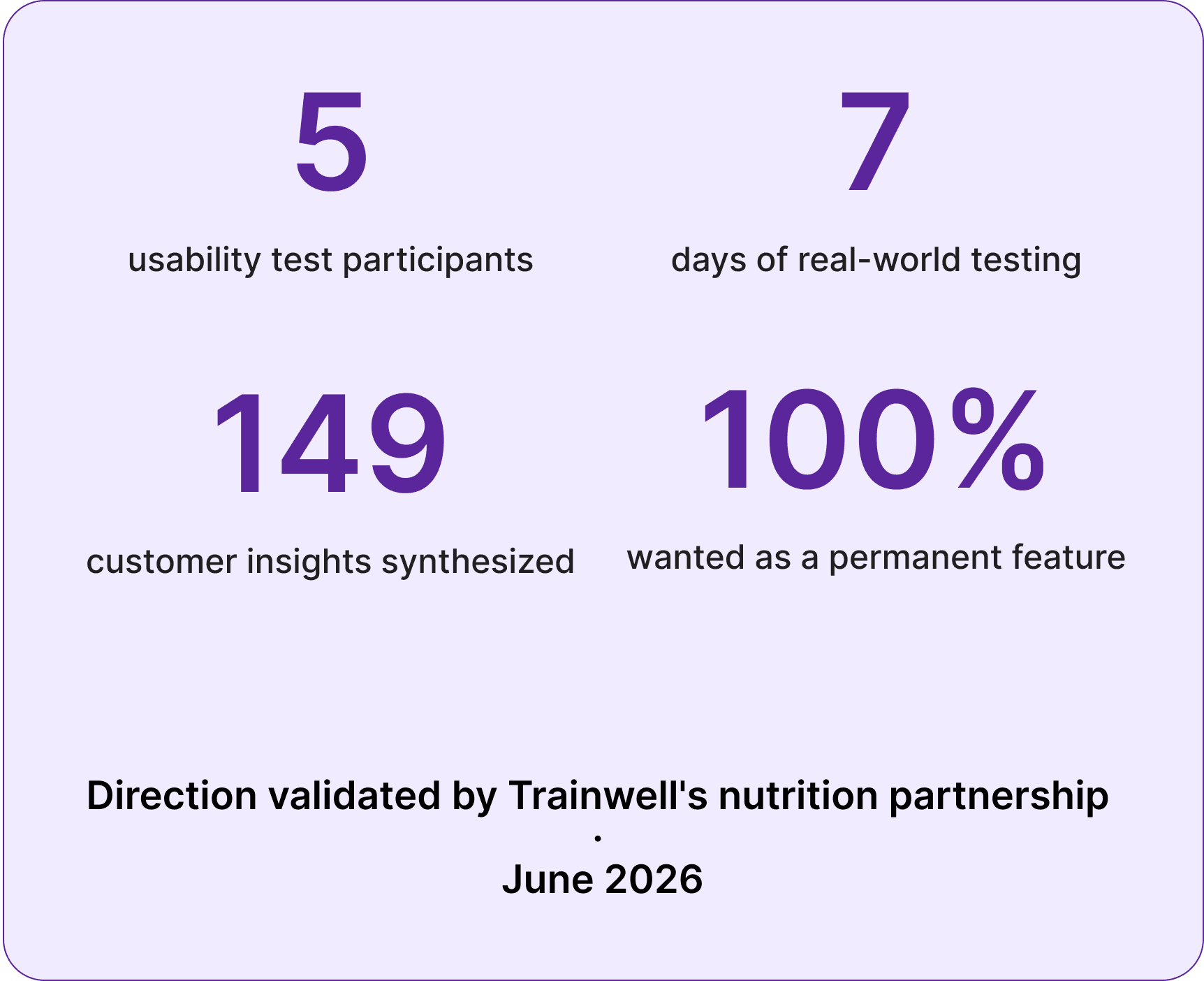
We synthesized 149 customer insights across desk research, 130 survey responses, and long-form behavioral interviews.
A narrative review of decision fatigue research found that by the end of a typical day, cognitive resources are depleted to the point that people default to whatever requires the least effort, and if the healthy choice requires one extra step, a fatigued brain skips it.¹
The pattern across our 149 synthesized insights matched: most nutritional breakdown happens in the evening, in social contexts, or under time pressure, moments when more information is the last thing that helps. Thus, we need to lean more on execution support rather than uncovering more data for the users.

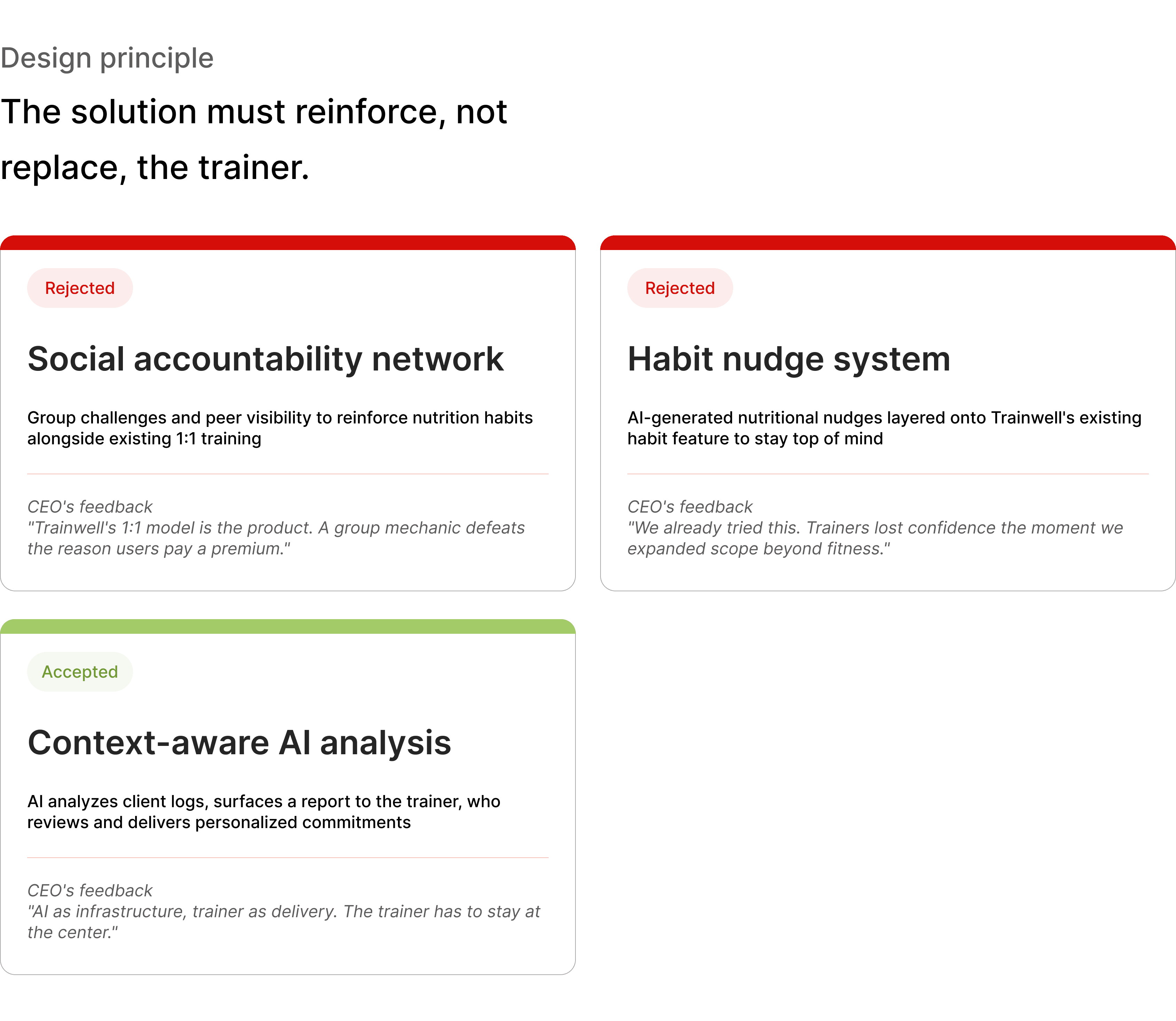
The solution had to reinforce the trainer. Anything that felt like a separate AI product would undermine why users pay a premium.
Trainwell's remote 1:1 model allows trainers to manage up to 160 clients per trainer, compared to the in-person average of 15–25 clients per week. Understanding that scalability is the business model, I owned concept evaluation and pressure-tested three directions with Trainwell's CEO, Matt Spettel, over four months of weekly check-ins. Social accountability was killed early since that went against Trainwell's competitive product advantage of the 1:1 trainer model. Habit nudges were killed too, since Trainwell had already tried them, and trainers lost confidence operating outside their expertise. That means, context-aware AI analysis is the last idea that made sense to proceed with building.
Log, reflect, commit. A 7-day behavior loop built around the trainer relationship, not the data.
Users log meals via photo or text during a time-bounded Food Awareness Week. AI analyzes patterns such as meal timing, energy correlations, and macronutrient gaps, and surfaces a report for the trainer, who reviews the AI-suggested commitments and pushes 1–3 to the client. The client commits with a single tap and checks in daily.
After a client feedback session in April, Matt flagged that asking users to reflect before eating, such as how hungry they are and what their mood is, created friction at exactly the wrong moment. I removed all pre-meal prompts and moved reflection to a single end-of-day check-in instead.


5 users. 7 days. Everyone reframed how they thought about eating, and 6 things still needed fixing.
All 5 participants reported a shift in how they thought about eating, not just what they ate. One user swapped late-night chocolate for Greek yogurt and was still doing it at our final session. 3 of 5 asked for their actual trainer to see their logs mid-week, which is a direct validation that the trainer relationship is the product, not the AI.
P1 | No meal/snack/drink type at entry — an apple logged as a "meal" skewed trainer interpretation |
P2 | No edit window post-submission — users who didn't finish their plate couldn't correct it |
P3 | Streak reset daily, never exceeded 1 — actively undermined the commitment mechanic |
P4 | All mood tags were negative — no way to log a good day |
A 7-day prototype validated the core loop. Trainwell has since moved in a new direction through a live nutrition partnership with Lose It! launched in June 2026.
All 5 test participants said they'd want this as a permanent feature (a small but unanimous sample), and the qualitative signal on the core loop was consistent across all sessions. Trainwell currently touches users 3–4x per week through workouts; a nutrition layer creates daily engagement, deepening both retention and the trainer relationship. And because the loop runs through the trainer rather than around them, it's differentiated from every pure-AI competitor in the category, meaning the trainer-led model is the moat that the nutrition layer protects.
Deciding where the AI stops turned out to be the product's central design problem.
Every decision ran through one filter: does this help the trainer, or replace them? Too much AI and users feel unmonitored and generic; too little and the trainer is overwhelmed and underqualified. What I'd validate next: commitment fatigue at week 5, once the novelty wears off. What I'd build next: tiered experiences by user segment — the Busy Optimizer (30–40% of users) needs different defaults than the Integrated Power User (10–15%).