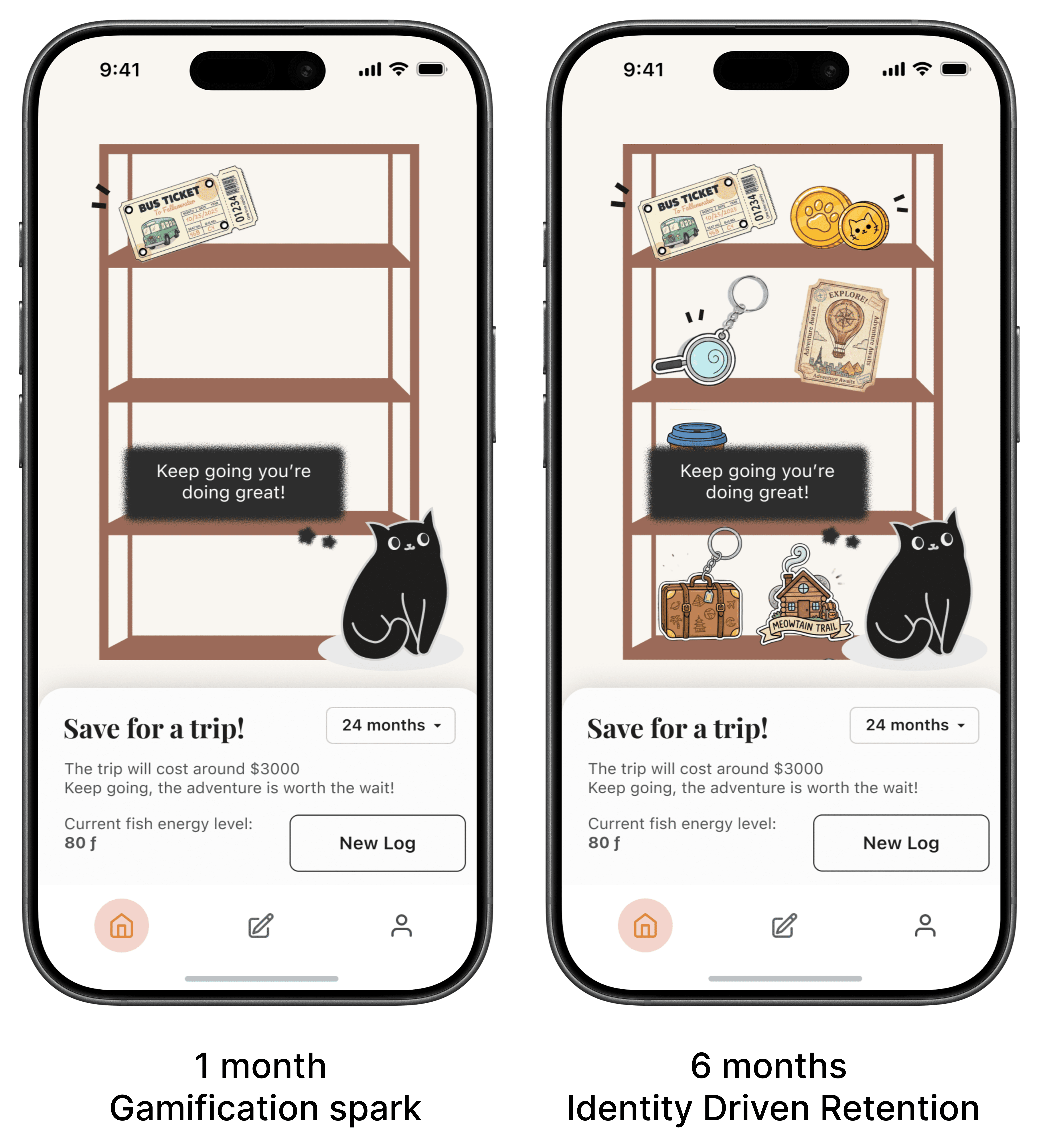
Persuasive Design
Fintech
Gamification

Guilt-based feedback makes people close the app
Most finance apps show what you overspent, what you missed, and how far behind you are. Instead of motivating early-career adults, that feedback makes people open the app less. The people who most need to build financial habits end up avoiding the tools made for them.
The design question:
How do we help people engage with their finances without triggering the response that makes them stop?

Engagement fails before behavior change even begins
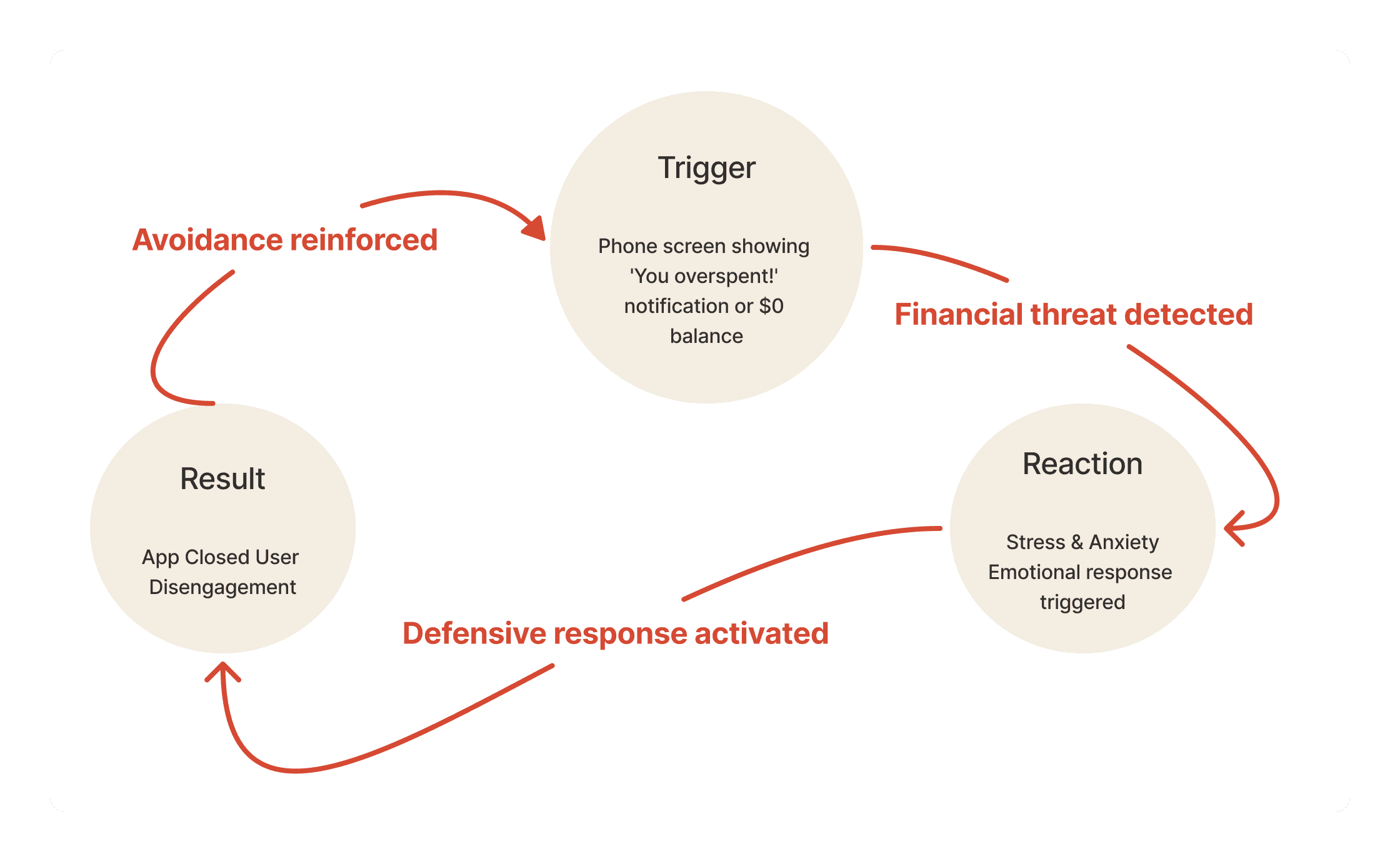
Financial apps don’t fail because users don’t care; they fail because the experience feels threatening. Seeing overspending or falling behind creates a predictable loop: users check their finances, feel worse, and then avoid checking again.
That avoidance breaks the system before any habit can form. So the constraint wasn’t adding better tracking or more insights. It was making engagement feel safe before users would stay long enough to change behavior. Every decision that followed was measured against that constraint: to reduce emotional friction first, then support action.
From financial tracking to identity-building
Instead of optimizing how clearly we show financial data, I reframed the product around how users experience progress.
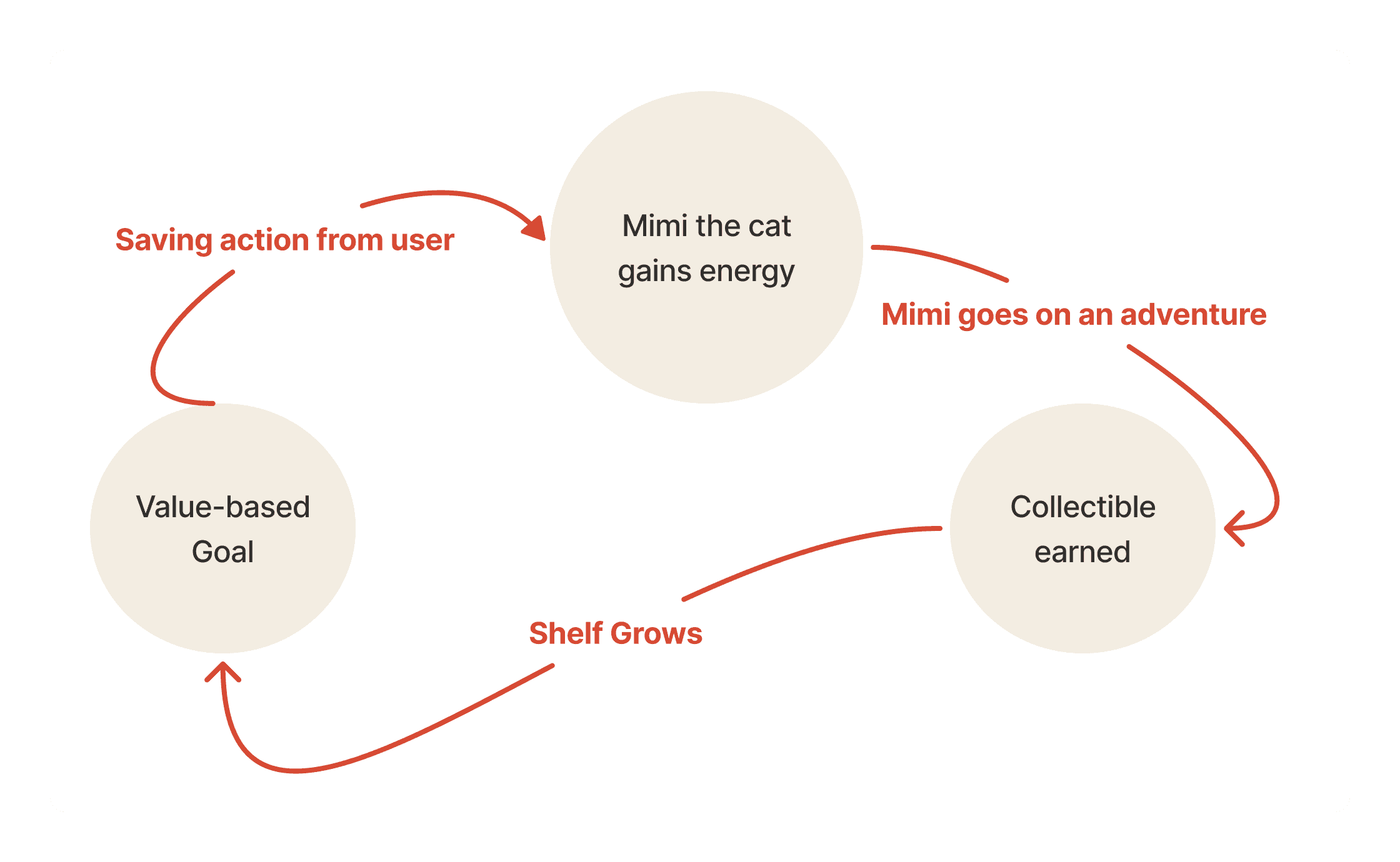
Each saving action becomes part of a personal loop:
value-based goal → saving action → Mimi reacts → collectible reward → growing shelf
The system shifts focus from “what you failed to do” to “what you’re becoming.”
This introduced a real product tension:
If the narrative layer softens the experience too much, users may disengage from the actual numbers, and without trust in the data, the product fails.
To resolve this, I designed a tiered system:
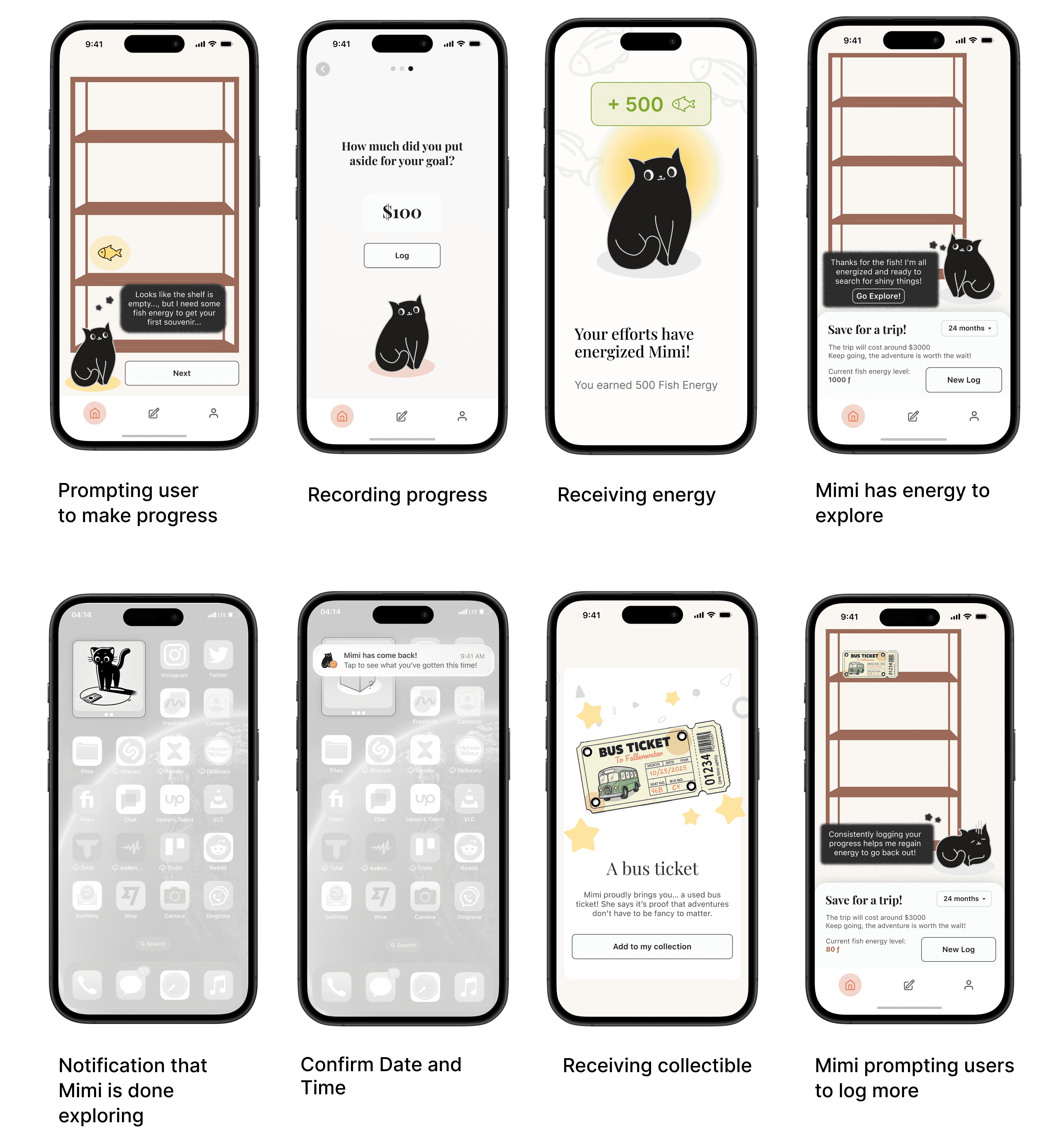
Narrative drives everyday engagement
Financial details surface at moments of intent (logging, reviewing progress)
The result is a system where emotional safety and financial clarity coexist without competing for attention.
This became the foundation for the full interaction system of identity onboarding, narrative feedback loops, and the collectible shelf.
Three rounds of testing, three things that needed fixing
Mimi felt like a decoration rather than a companion. Users didn't connect their actions to her adventures. The fix: we made the causal link explicit in the subsequent rounds.
Progress indicators were confusing. The connection among the saving action, the collectible, and the shelf wasn't clear either. The fix: we simplified the goal-to-reward mapping.
Onboarding ran too long before users experienced any value. The fix: We moved explanations to the moment they were needed.
What held across all three rounds: narrative kept anxiety down, collectibles felt meaningful, and goal-setting was the most resonant moment in the experience.
Identity drives sustained engagement, not rewards
Users who connected saving actions to their personal identity—“this is who I’m becoming”—stayed engaged with the goal-setting loop even when the collectibles stopped being the draw, a signal that identity, not the reward, was driving engagement.
In contrast, users primarily motivated by collectibles showed strong initial engagement but dropped off once the reward lost novelty.
This reinforced a core product principle: engagement holds when progress is tied to identity rather than external rewards.
The shelf is just the beginning
Longitudinal research: Does identity-based motivation hold past the novelty of collectibles? A 6-month study would start to answer that.
Expanded goals: Debt repayment, emergency savings, and investing, each with its own narrative frame.
Monetization: A subscription model that reinforces progress ownership rather than gating access to data.