Problem
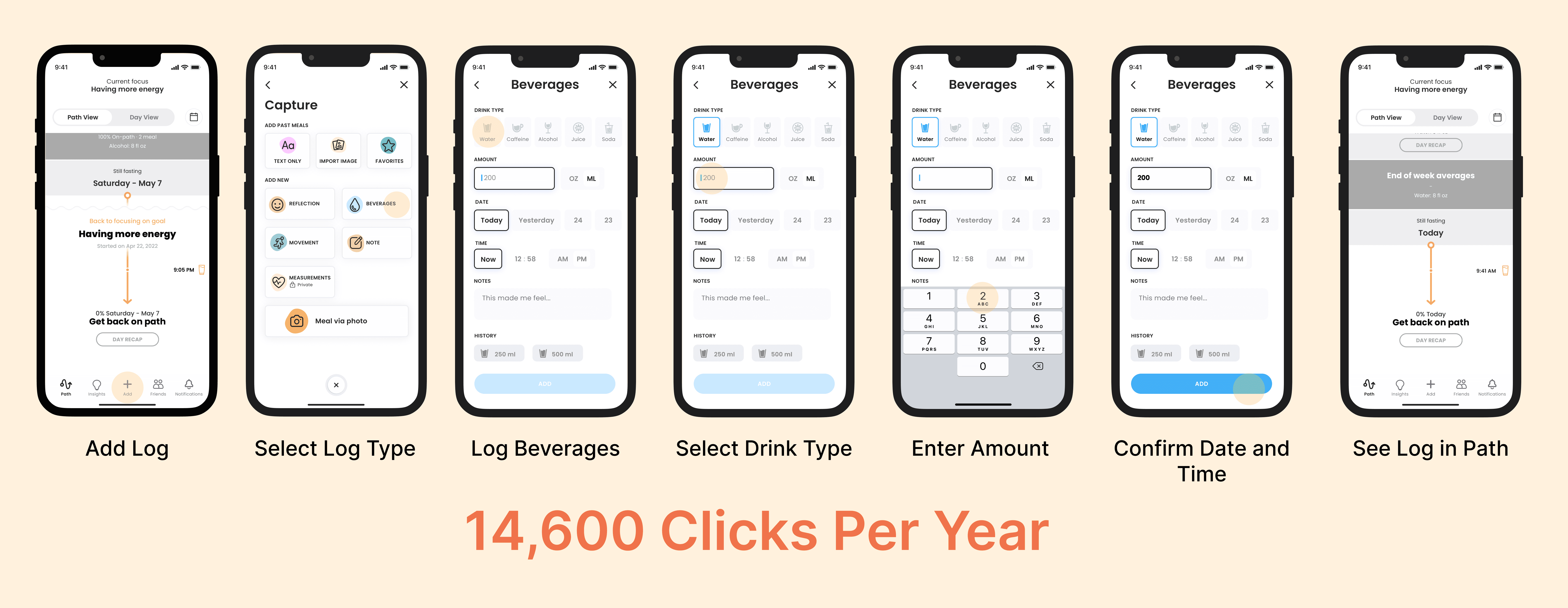
14,600 taps a year just to track water.
Logging drinks and movement took too many taps. Eight glasses of water took about 40 taps and nearly 3 minutes, so people put it off and eventually stopped. There was also no way to set a goal or habit, and as a mindful food journal, Ate didn't want the streaks and competition that workout apps use to bring people back. With 6 weeks and 3 designers, we fixed logging first and built habits into it.



Testing
In our first version, testers couldn't distinguish quick-add from regular logging.
In Round 1, both flows started from the same home screen with no explanation, so testers had to guess what quick-add meant before choosing it.


Solution
A first-time prompt led people straight into setting up quick-add, and after that, water takes one tap.
In Round 2, a call-out after the first regular log pointed people to quick-add, and a setup screen let them choose what to quick-add, which cleared up the confusion. Habits run as 3-, 5-, or 7-day trials instead of permanent streaks, which fits Ate's "curious, not critical" approach.
Outcome
From 40 taps a day to 8, shipped in Ate's production app 12 months later.
We set out to make drinks faster to log and to let people build habits from what they already track, while keeping meal photos at the center of the app. Both shipped in Ate's 2023 app a year after our handoff, so the design held up through Ate's own product cycle. The app has 100K+ downloads on Google Play and a 4.8 rating on the App Store.
Metric | Before | After |
Taps per log | 5 | 1 |
Time per entry | ~20s | ~12s |
8 glasses/day | ~3 min | ~90 sec |
Habit trials sit inside the logging flow, so the retention feature is part of something people already do every day.

Next steps
Next, I'd shrink habit setup to one screen and add an insights layer.
I'd merge the intention prompt and the frequency setting so habit setup fits on one screen. Then I'd add an insights layer that turns the emotional data Ate already collects into patterns and small progress moments.

Next work
Connie Agentic Commerce
Shoppers were deciding on Reddit and free AI chatbots before they ever reached Consumer Reports. For our CMU MHCI capstone, we built Connie, an agentic shopping assistant that brings CR's lab tests and owner reviews to the retail sites where people shop.